
Portrait of a grifter
The making of Lisa Jane Spencer

It’s 2017 and a young Melbourne musician – performing under the stage name Aeora – is struggling to break into the industry.
Aeora’s situation wasn’t entirely hopeless. Her music got a couple of write-ups in small industry magazines, some people called her a singer to watch, there was the occasional gig. But still, it was a slog.
Aeora reflected on the struggle in an interview with a small, online publication for women in music.
“I acknowledge I’m a white cis straight female, and with that comes some privilege (although not as much as if I were a white straight cis male),” she said.
“But the industry is still not representative of trans people, queer people, people of colour, and to top it off, still not really represented by females.”
Aeora never did get her break in music. But she did become famous.
Nine years later, she would post a video on social media where she pretended to identify as an Aboriginal woman. The punchline, if it can be described as that, was her sniffing petrol from a jerry can.
She’d long since dropped the moniker Aeora, and was proudly posting under her real name: Lisa Jane Spencer.
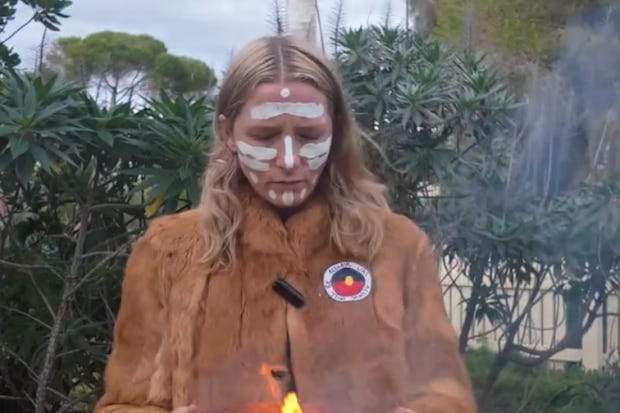
This video did exactly what it was intended to do: cause outrage and attract attention. Spencer acquired thousands of followers, national news coverage, and lost her job. She’s now following the well-trodden path to becoming an alt-right grifter.
I am broadly of the opinion that the best way to deal with people who are intentionally provocative online is to ignore them. In the case of Spencer, I am certain there would be no greater punishment.
But I’m making an exception to my own rule here, because Spencer is an interesting study. Despite some efforts to hide her past, evidence of her dogged pursuit of fame is scattered all over the internet.
In the last decade, Spencer has attempted to be a progressive musician, a spiritual leader, a comedian, and is now restyling herself as a right-wing agitator. In all her various guises, she’s spoken at length – in interviews and on blogs – about her unstable mental state and deeply personal motivations.
When these fragments are pieced together, what emerges is a portrait of a fragile and painfully ordinary young woman. A damaged individual who constantly sought external validation, failed at every turn, and eventually limped to the only group where – in all her mediocrity – she would be celebrated.
It’s a depressing but fascinating story.
How did a shy musician who once spoke about the underrepresentation of “people of colour” end up at the centre of a self-inflicted media storm?
We start in Melbourne.
Spencer grew up in the wealthy suburb of Balwyn with her brother and well-off parents. But it wasn’t an easy childhood. According to Spencer, her parents fought constantly “to the point of police being called one late night”.
The instability made a deep impression. Spencer felt abandoned, neglected, and like she was “too much”. She struggled to express her emotions as a child until, she says, she found music. Writing songs became a method of communication, and a way to purge her emotions.
From the age of four, she was using her father’s piano. Soon after that, she started writing her own songs. By the age of thirteen, she had a YouTube channel where she would post covers and her own music.
This would lead to a foundational moment which would shape Spencer to this very day. An incident which goes some way to explaining her current online persona.
Like so many traumas, it unfolds in high school.
“There was one key moment in my teenage years, where I wrote a song about this situation that I was seeing about this particular girl and my friend,” Spencer said.
Spencer liked the song enough to record it on video, and then put it online. It was a decision that would haunt her for many years to come.
“The song was quite mean, unintentionally,” she said. “The teachers called me in because I put it on YouTube, and they were like, you need to take it down.”
“Anything that I did, I feared that same response. That I was going to hurt someone, that I’m a bad person.”
“I had to face that fear. Of being rejected, of being the bad person, of being cast out.”
As an adult, Spencer has clearly examined this moment many times. But with much inner reflection, “shadow work” and journaling, she has – generously – absolved herself of guilt.
Spencer mostly put this chapter behind herself, and pursued a music career in earnest after leaving high school. A coworker she met at a cafe became her manager, and she started pulling together an album. But studio hire, PR teams, headshots, and music producers don’t come cheaply.
Financial issues are a recurring problem throughout Spencer’s life. She blames her father’s indulgence.
“My dad just gave me a lot of money in my bank account and didn’t really teach me much about it,” she said in one interview.
By her own admission, she would waste money and then fall into a pattern of borrowing from partners or her mother. Eventually, these financial problems scuppered Spencer’s first serious attempt at being a musician.
Or so she says.

I’m no music critic. But by my measure, Spencer and her expensive team of helpers wrote an album which was fine. Her songs are nicely produced, she is a reasonable vocalist.
But it’s also completely banal. Music which neither sinks to the bottom nor rises to the top.
When Spencer is interviewed at this point in her career, she is also painfully uncomfortable. She gives short, closed answers which leave the interviewers scrabbling for follow up questions. She certainly does not crack any jokes, or even laugh when they are made.
Her charisma was never going to bridge the void left unfilled by her musical talent.
Lisa Jane Spencer’s next chapter takes place in Byron Bay.
At this point, it’s the early 2020s. Spencer’s money situation is dire, and the longed-for music career is on hold. Perhaps in a state of desperation, she discovers online spiritual leader Lacy Phillips – a women who sells an expensive program for manifesting one’s desires. This process involves Spencer examining her life, reflecting on her wounds, and unpacking old traumas.
Clearly inspired by Phillips, Spencer started posting on social media more regularly. She talked about wellness and spirituality.
The videos (few of which remained at the time of writing, now completely gone) were excruciating to watch. In a sing-song voice Spencer would talk pointlessly on broad topics like ‘connection’, ‘the universe’ and ‘community’. People seeking guidance would have been better off eating Kmart motivational posters, regurgitating them onto the floor, and interpreting the pulpy mush.
Even Spencer admits this was an odd phase in her life.
“I kind of explored doing the coaching thing and started to put some of those teachings online,” she said. “But it didn’t really do anything.”
But perhaps there is something in manifestation. Around this time Spencer says she asked the universe for a viral social media moment. Before long she received it.
To everyone’s surprise, it was comedy.
“I’m sure it felt a bit left-of-field for my friends and family who followed me,” she said.
“I had partners that never thought I was funny. I’ve always been, you know, a little bit funny.”
In all of her interviews I’ve seen no evidence of it.
Spencer had started making videos where she mocked what she saw as the ‘contradictions’ in people. The first group she turned her attention to were the very people she had been attempting to become – Byron Bay spiritual coaches.
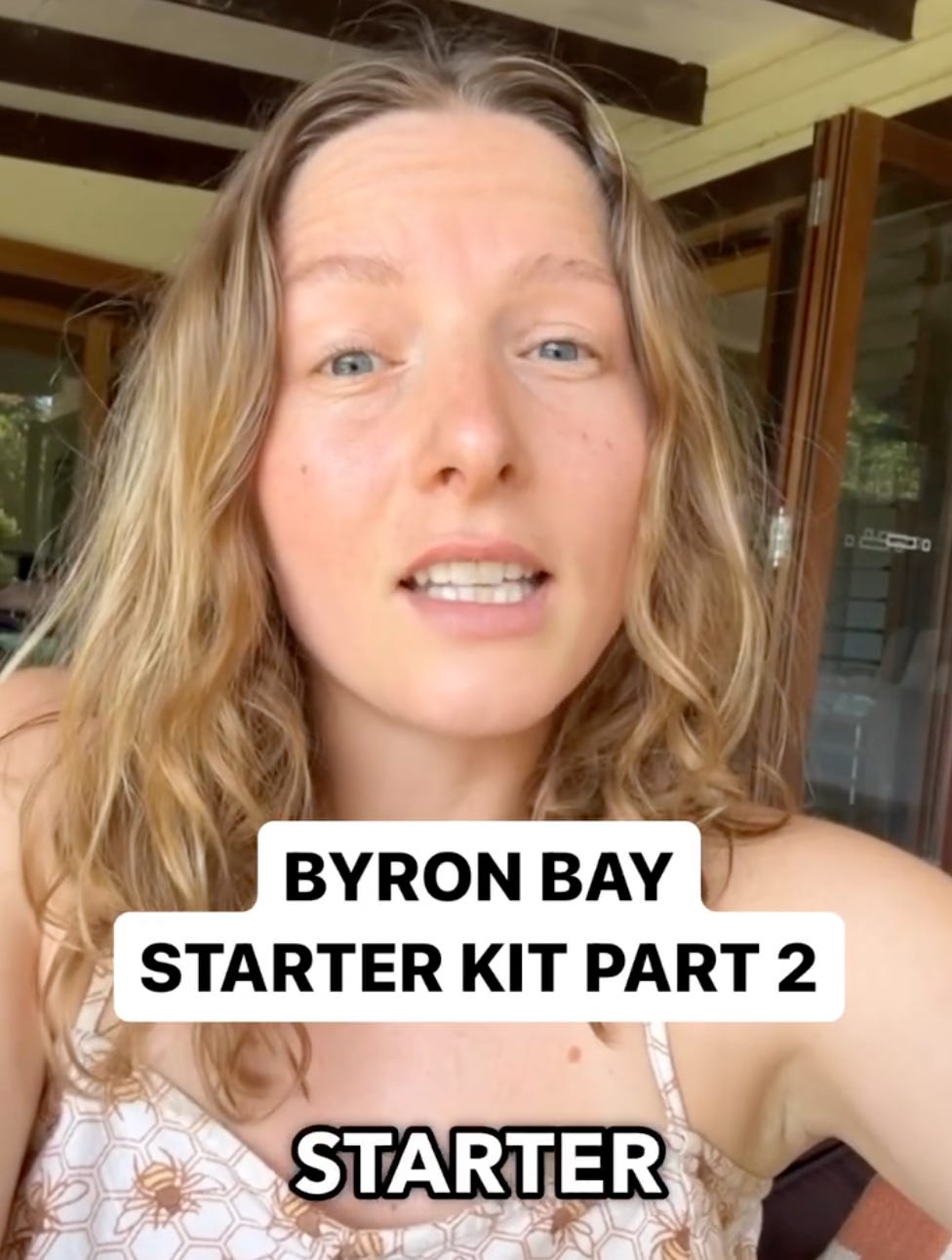
These were largely harmless. No one is going to bemoan the marginalising of influencers, after all. But even in these early videos you can see a mean edge.
You also get the sense that comedy was never the real goal for Spencer during this phase. She hoped her social media success would translate, at some point, back to music.
Her audience wasn’t interested.
“When the comedy stuff was doing well, I put up a video of me singing and people thought it was a joke,” Spencer said. “It was like a knife to my heart.”
Undeterred, she tried to launch one more album. It failed to find a listenership.
The music dropped off Spencer’s account.
A darker, more cynical edge crept into her videos. They gained more traction.
Then, in June last year, she decided to try stand-up comedy in Austin, Texas. She couldn’t quite afford the trip, but her mother once again came to her rescue with the extra money.
Just four days after landing in Austin, Spencer miraculously achieved one of her biggest goals. She got a spot on Kill Tony, a live podcast where comedians perform a quick, one-minute set and are immediately roasted by the host and guests.
Spencer would quickly discover there is a big leap between making short, snarky videos on Instagram and doing a gig on stage.
The audience is warm as she takes the mic.
“Are we still pretending white people—” she stumbles on her words here and starts again.
“Are we still pretending we don’t say the ‘n’ word? Like when they’re not around? I remember learning about it… my brother got back from a friend’s house. And he was talking about this cereal he’d had. You call it Cocoa Krispies, we call it Coco Pops and he called them n-pops.”
She pauses here for laughter. There is none.
“And my favourite is just doing it in the car. Listening to Kanye. I’m talking about eating Nutella.”
This is the punchline. She waits for laughter again. The silence stretches into infinity.
“Oh that’s it?” asks the host.
“Yeah,” she replies.
Spencer persevered with stand-up comedy for a couple of months in Austin, then a few more months in the United Kingdom. If she recorded those attempts, she has wisely not uploaded them onto the internet.
Snarky little social media skits it would have to be, then.
The meaner Spencer got, the more right-leaning her content became, the more views her videos would get. But she wasn’t entirely comfortable with the direction her content was taking, though. Spencer reflected on her work in a blog post.
“My intent is never to hurt anyone I make parodies on, but I see how it could.”
And then there was a moment of real introspection.
“Pointing out someone’s flaws and contradictions while ignoring my own is hypocrisy. If I’m calling for more responsibility and ownership, I need to hold myself to the same standards.”
But, again, she immediately absolves herself of guilt. The very next paragraph reads:
“I stand by the jokes I’ve made and the parodies I’ve done.”
She finishes this piece with the line: “Don’t hate the player, hate the game”.
So what is the game for Spencer? To get everyone’s attention? To make money?
On both fronts she has achieved her goal. After being fired from her job at a wellness centre, Spencer set up an online fundraiser. More than $40,000 has been donated.
Her mother, I’m sure, will be relieved.
But if Spencer could choose between being a broadly-hated provocateur, or the woke Melbourne musician she once blew her life savings to become – it’s hard to imagine she’d prefer the former.
In having manufactured this life, her own greatest fears have come true. Being rejected, being the bad person, being cast out.
Only Spencer can say whether the attention was worth it.
As a working comedian myself I can’t say I was shocked by any of this, however, the whole thing has been so irritating. This trend of rage-baiting with shitty online videos and then hiding behind it being “comedy” is exhausting because it then draws in people with actual comedy experience who defend the art form (yes I feel weird calling it an art form lol) and are then labeled the “woke mob” or whatever other insults simply because they expect better. The truth is, comedy is hard to do and whether it’s parody or satire, there are still markers you have to meet and insight you need to demonstrate for it to qualify. Her content is none of those things. The only thing I take comfort in is that anyone who makes lazy fake comedy like this never lasts much longer than the initial outrage phase. Because you have to have something FUNNY to offer and I’m not confident she does. But I encourage her to try and book some paid comedy club spots in Melbourne if she’s short on cash and see how that goes for her.
My jaw literally dropped open at the description of her Austin ‘comedy’ gig. That someone would travel halfway around the world to deliver that sixty seconds of bilge water beggars belief. Who did she think was going to laugh at that?